I Made Peace With Not Having Money Instead of Asking Why
- Chrysanthia Gaza
Prefer to watch? The video's below. Prefer to read? Keep going — this one's for you either way.
For a long time, I made peace with not having enough instead of ever asking myself why. It felt easier, safer even, to just accept it — "this is how much I have, this is how much I'll always have" — than to actually sit with the harder question of why I believed that in the first place.
There's a cycle around money that nobody talks about directly: you're shamed for not having it. You're shamed again for admitting you have ambition and actually want it. And then you're shamed a third time once you get it. There's no space anywhere in that cycle to just be celebrated, or comfortable, or at peace with money.
What strikes me most is how quick we are to bond over not having it. Tell a group of people, "I only have $20 left this month," and watch how fast everyone jumps in — "oh my god, me too, I only have $15, can you believe it." There's real excitement in that moment of solidarity. But if you tell that same group you're doing well financially, the room changes completely. That's disturbing to me. Why would you want to be surrounded by people who are comfortable having $20 to their name for the rest of the month? How is that person going to pull you forward? How are they going to give you real financial guidance to get either of you out of that situation?
The stories we never questioned
I think we have to stop believing the stories our parents told us about money — and stop believing everything TV taught us about it too. We have to stop denying ourselves permission to even say, quietly, to no one but ourselves: I want more money. Not because wanting it is shameful, but because we've turned "wanting money" into something greedy, evil, or wicked by default, without ever asking why we actually want it in the first place.
Do you want more money because you grew up with four siblings in one bedroom, and you don't want your own children to live that? Because you need a reliable car to get to work? Because you want to send your mom on a vacation while she's still able to enjoy it? These are real, specific, human reasons — and they never show up in the way money gets portrayed. It's always someone with money or someone without, no middle ground, no nuance about why.
Chasing a number without asking why
Even the goals we set can be borrowed instead of examined. People online talk about hitting $10k a month, and that's fine for them — but if you pick up that same goal, ask yourself why. Is it because it's a nice round number, or is there something real underneath it? Do you have kids to put through school? Student loans to pay off? Do you need warmer clothes because it's cold where you live? These specifics matter. They're the difference between chasing a number and actually knowing what you're working toward.
And I don't believe money makes someone good or bad. I've heard genuinely disturbing stories about people with no money, and I've heard incredible stories of generosity from people who have a lot. Sitting there telling yourself you're the "holy one" because you don't have money doesn't actually help anyone in front of you who needs something tangible. Prayers and good intentions matter — I believe that — but there's a physical world and a non-physical world, and real help usually requires showing up in both.
Where the story actually started
A lot of this goes back to what we absorbed as children, without ever choosing to. If your mom was always in the kitchen with the checkbook, stressed, repeating "there's never enough, there's never enough" — you took that in as fact, the same way children take in anything said around them. And then no matter how many raises you got, no matter what job you landed, it kept feeling like it was never enough. Not because the math didn't add up, but because the story got there first.
I had to sit with that myself and pull away from what I'd absorbed growing up. In a course I once took, the very first exercise was simply: write out the money stories you heard growing up. What your family said about it, how people around you handled it, what was said about people who had it. It was eye-opening in a way I wasn't expecting.
Questioning the story instead of the amount
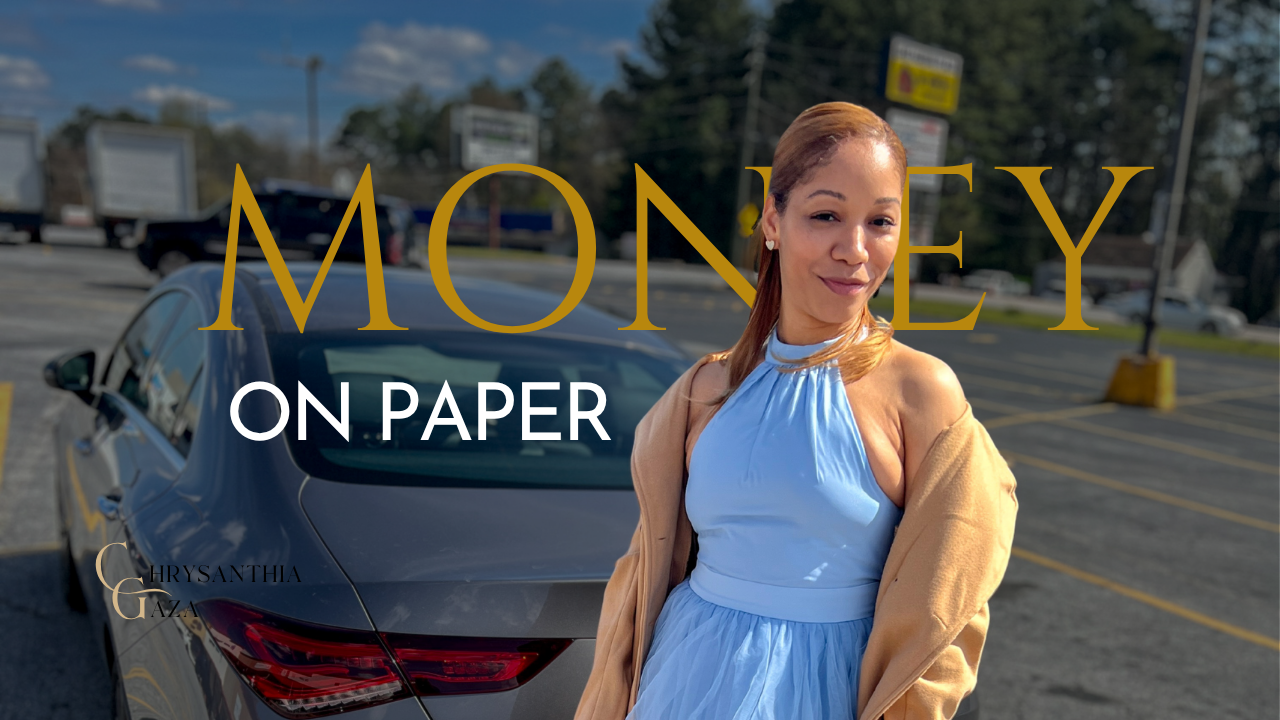
That's part of why I created Money on Paper — because I didn't want to just be passive about something this important. It's not really about hitting a number. It's about learning to tell the difference between what you actually believe about money and what you only absorbed by hearing it over and over. It's about questioning those inherited stories and eventually giving yourself permission to decide, on your own terms, that you want more — for whatever reason is actually true for you.
It's a simple practice: pick up a pen and paper, and write down what you heard about money growing up. Ask yourself if you still believe it. Ask if there's a moment in your own life that already proved it wrong. That part can be uncomfortable, because it can feel like you're saying your parents or grandparents were wrong. They weren't wrong for their circumstances. Two things can be true at once — their reality was its own, and it doesn't have to be the blueprint for yours.
At some point, we have to take responsibility for our own financial future, and decide whether we're going to keep making peace with not having, or finally ask why — and start writing a different story.
My course - Money On Paper helps you to do just that! Check it out here 👇
You're invited 💌
Join my community & grab 'Off Duty', a free 🎁 guided journal for women ready to choose themselves.